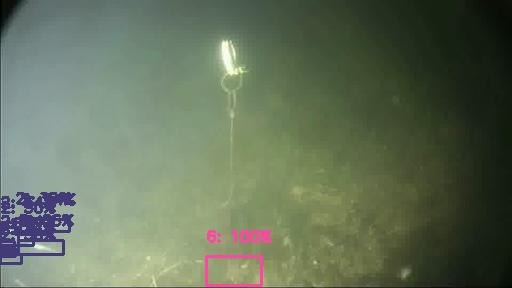
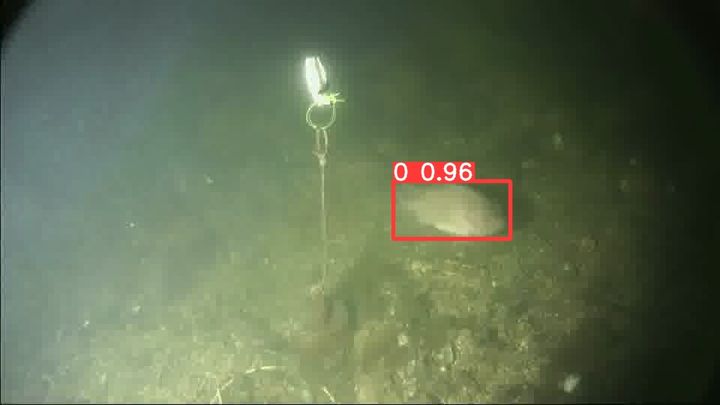
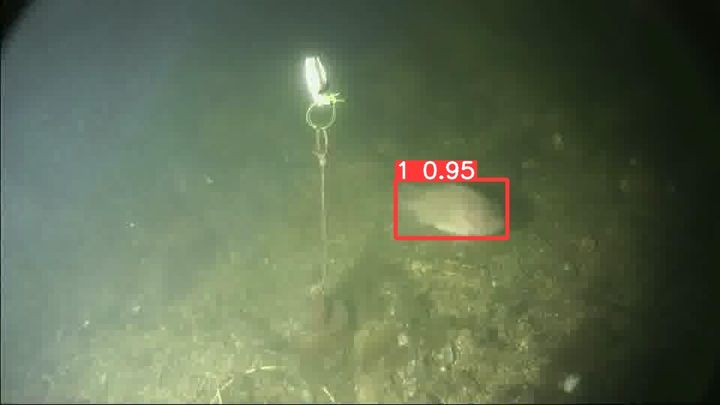
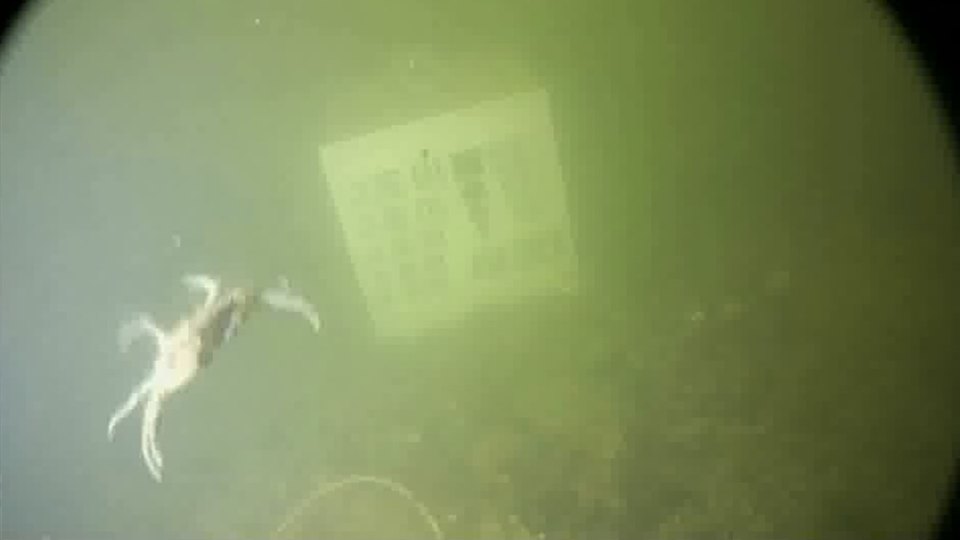
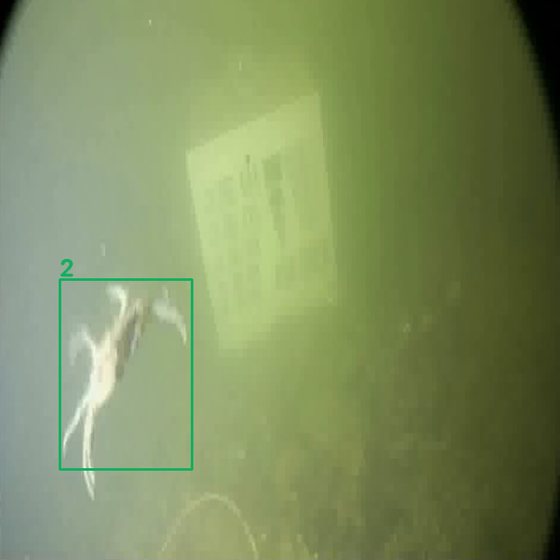
Frames from nine metres under Limfjorden, Denmark. Every box is a prediction saved by a detector trained in this
project; the two YOLO panels show the same held-out test frame.
1Why underwater detection is hard
Seawater is a hostile lens. It absorbs light, scatters it back into the camera and fills the frame
with drifting particles. A detector has to find a shrimp a few dozen pixels wide in that.
Automated monitoring of marine life is how we count populations, notice invasive species, check the effect of
fishing and pollution, and keep ships off the seabed. Cameras are cheap; people watching the footage are not. The
catch is the footage itself. Brackish water carries silt and plankton, visibility changes with the tide and the
weather, and a stationary camera sees the same rock, rope and calibration board for months while the animals it
is meant to watch appear small, blurred and half-hidden.
The paper calls this a natural adversarial environment: the corruption is not crafted by an attacker,
but it degrades a network in much the same way. Try it on real frames from the dataset.
Water conditions playground
IllustrationPick a frame, then move the sliders or try a preset.
What the network receives
RMS contrast of the frame–
Dashed outline: the frame as recorded. The number is the standard
deviation of luminance, a simple proxy for how much edge information survives.
The effects are simple image operations for intuition, not a physical model of light in water.
The frames themselves are unedited Brackish frames.
Low contrast
Turbidity pulls every pixel towards the colour of the water. Edges and textures, the cues a CNN relies on,
fade first.
Tiny, moving targets
Small fish and shrimp cover a few dozen pixels and move between frames. They are the hardest classes for
every detector trained here.
Real time
Monitoring runs on continuous video, often on the edge. That rules out slow two-stage detectors and favours
compact one-stage models.
2The Brackish dataset
Three cameras bolted to a pillar of the Limfjord bridge between Aalborg and Nørresundby,
nine metres below the surface, recorded by Aalborg University and annotated frame by frame.
The Brackish dataset (Pedersen et al., CVPR Workshops 2019) was filmed in real, murky coastal water rather than
on a clear reef or in an aquarium, and its authors release 14,518 annotated frames. Videos are filed into folders by
what they mostly show, and every frame carries bounding boxes for six object classes.
15,084frames extracted at 960×540 and paired with label files
logged in 0_Dataset
10,995frames left after dropping those with no box
logged in 0_Dataset
6object classes, from shrimp to large fish
Brackish annotations
70 : 20 : 10train, validation and test split in the released Roboflow version
paper Table 2
What is in the frames
Switch between the three ways the data is counted.
From raw video to training data
Every detector in this project consumes the same frames, but each toolkit wants its labels in a different file
format. Step through the preprocessing, then drag the box to see what a single annotation looks like on disk.
Preprocessing and annotation formats
Click a step. Drag the box, or its corner handle.
Download the Kaggle release: AVI videos filed by category, with YOLO label files.archive.zip, unpacked to dataset/videos/<category>/
Extract every frame with ffmpeg, scaled to 960×540 with bicubic resampling.ffmpeg -i {name}.avi -vf scale=960:540 -sws_flags bicubic {name}-%04d.jpg
Match frames to label files by name and rename both to a running index.15,084 images and 15,084 label files
Convert PNG to JPG with ImageMagick.mogrify -path images -format jpg *.png
Remove frames whose label file is empty.10,995 images remain
Normalise box coordinates to the 0–1 range and shift class ids to start at 0.normalize_yolo_coords(), class_map
Split, then export per toolkit: YOLO text, COCO JSON or Pascal VOC XML.Roboflow export: 7,000 / 2,000 / 1,000
crab
Format
3Anatomy of the detector
A one-stage detector is three parts: a backbone that sees, a neck that mixes scales, a head that
decides. DeepSeaNet keeps EfficientDet's recipe and proposes changes to each part.
From a frame to a box
Step through it, or click a block.
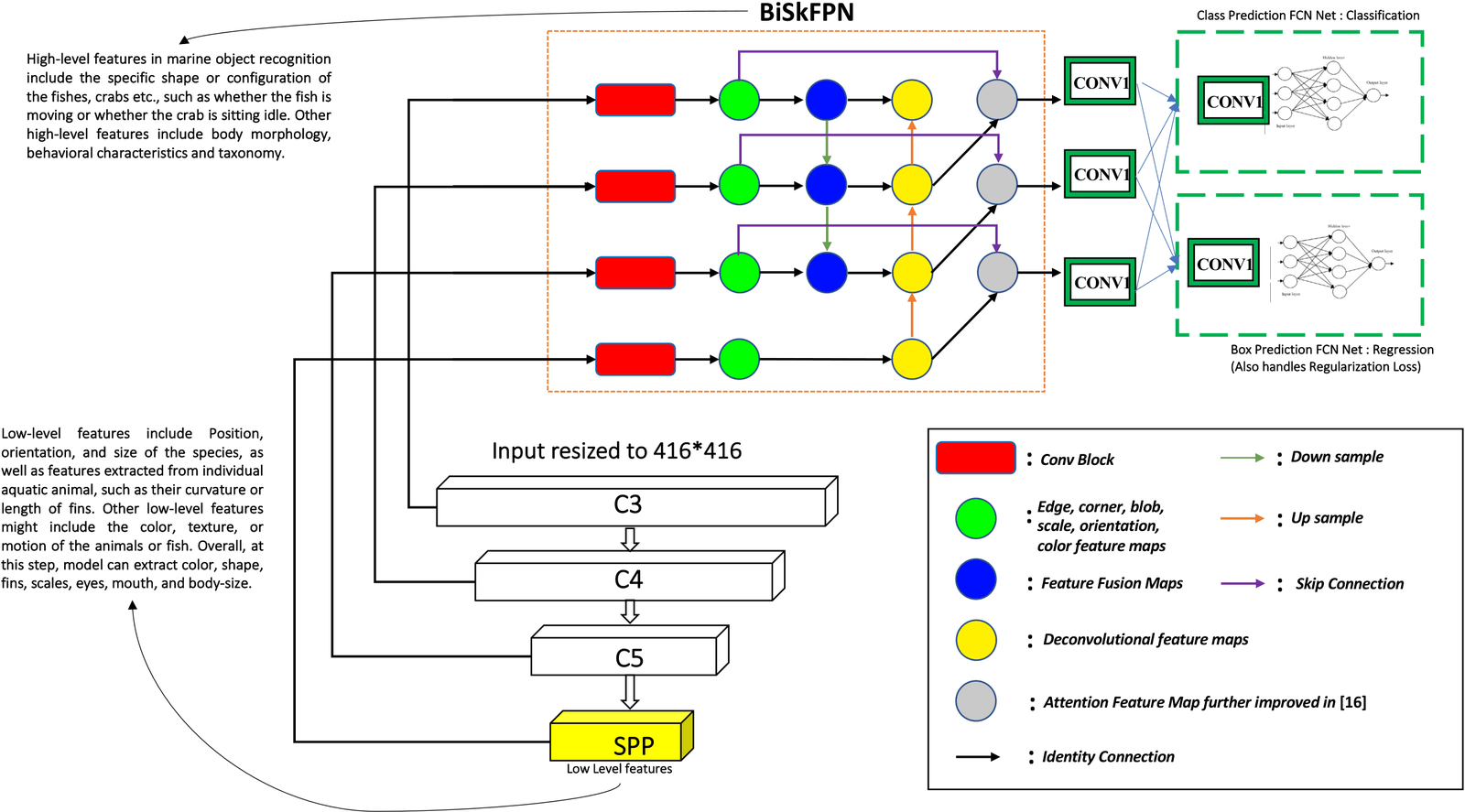
Figure 1 of the paper. The proposed pipeline: backbone features at several scales, the BiSkFPN
bottleneck that fuses them, and fully connected class and box networks at the head.
The neck: how scales talk to each other
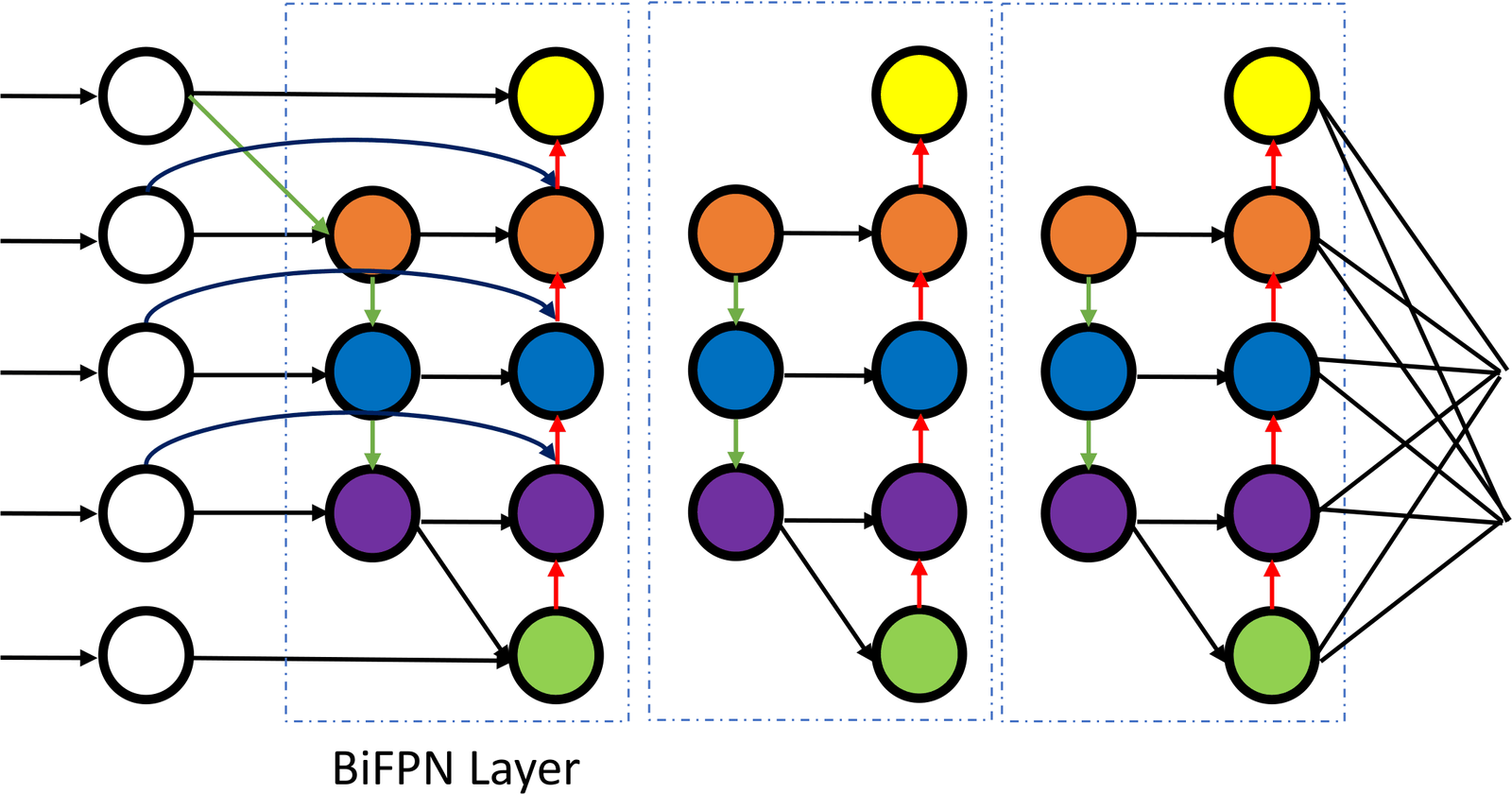
A small shrimp is only visible in the high-resolution P3 map; a large fish fills the coarse P7 map. The neck
decides how information flows between them. Each design below adds paths the previous one lacked. Hover an output
node to light up every input it can draw from.
Feature pyramid explorer
Choose a design, then hover or tap a node in the right-hand column.
Hover an output node to trace it.
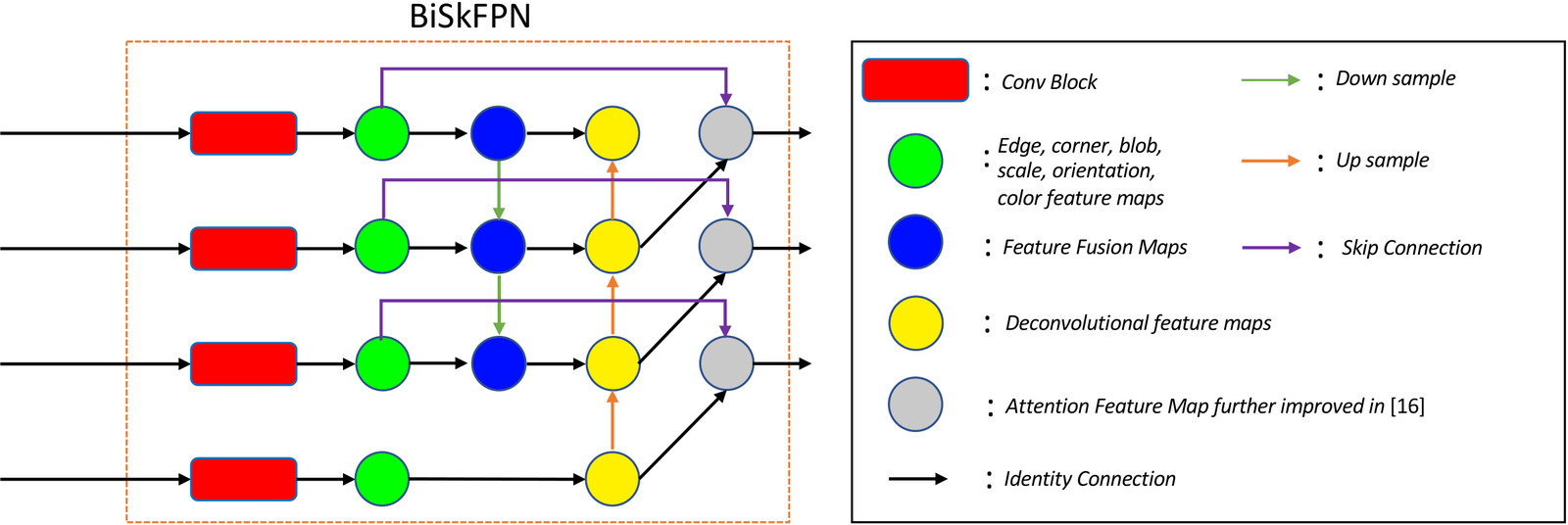
Figure 2. BiFPN, the neck of the original EfficientDet, repeated as stacked layers.Figure 7. The proposed BiSkFPN, with deconvolutional feature maps and skip connections.
The backbone: doing more with fewer weights
EfficientNet replaces ordinary convolutions with mobile inverted bottleneck blocks (MBConv). A 1×1 conv
expands the channels, a depthwise conv filters each channel on its own, and another 1×1 conv projects back
down. The paper also argues for the Swish activation over ReLU. Both choices are easy to feel with numbers.
MBConv parameter counter
Swish against ReLU
Swish(x) = x · σ(βx). It dips slightly below zero and has a non-zero gradient
for negative inputs, so weak, noisy activations are damped rather than cut to zero.
The head: one loss, three pulls
For every anchor box the class network predicts species probabilities and the box network predicts offsets.
Training minimises a weighted sum: a classification term, a box regression term weighted by α, and an
ℓ2 penalty on the weights. The paper writes it as
The EfficientDet-Lite0 run in the repository logged each of those terms for all 350 epochs, so the balance can
be read straight off the training log. In that implementation α = 50 and β = 1.
Where the training loss comes from
Repository logHover for values. Drag α to reweight the logged terms.
Six detectors, one dataset, five repetitions each. This section shows the paper's own tables;
the next one shows what the committed runs in the repository logged.
mAP over five runs
Paper, Table 5Each dot is one run. Hover for the value.
Axis
Class-wise mAP
Paper, Table 6Click a column header to sort.
Column names follow the paper, which labels classes by Brackish video category. Darker cells mean
higher mAP. See the notes in section 7 on how this table relates to Table 5.
98.63%mAP reported for EfficientDet with adversarial learning
paper, abstract
98.04%mAP reported for YOLOv5 with adversarial learning
paper, abstract
350training epochs for every model, weight decay 5×10⁻⁴
paper, Table 4
Experimental setup (paper, Table 4)
Setting
YOLOv5
EfficientDet
Detectron2
Epochs
350
350
350
Backbone
CSP-Darknet53
EfficientNet
ResNet
Neck
PANet
BiFPN
RPN + FPN
Head
YOLOv3-like
YOLOv3-like
RPN + RCNN
Train / val / test
7000 / 2000 / 1000
7000 / 2000 / 1000
7000 / 2000 / 1000
Annotations
YOLO TXT
COCO JSON
COCO JSON
Optimiser
SGD, lr 0.1
SGD + Adam, adaptive
SGD + Adam, adaptive
Activation
Leaky ReLU
Swish (neck), Leaky ReLU (head)
Sigmoid (box), softmax (class)
Hardware listed in the paper: AWS EC2 p3dn instance, NVIDIA V100 GPUs, 96 vCPUs, 31.2 USD per hour.
Where the design choices came from
The related-work study reviews five EfficientDet variants built for other hard imaging domains. Each contributed
an idea, or a warning, for water.
Oil tanks from orbit
Attention and residual deformable 3D convolutions damp cloud and haze noise in remote sensing.
100 mAP · Xu et al., 2022
Crop circles in the desert
YOLOv5 against EfficientDet: EfficientDet scores higher, YOLOv5 generalises to more examples.
91 mAP · Mekhalfi et al., 2021
Ultrasonic defects
Anchor aspect ratios found by K-means with Jaccard distance for extreme box shapes.
89.65 mAP · Medak et al., 2021
Military ships
Multilayer attention with deep feature fusion to separate ship types in optical imagery.
97.05 mAP · Qin et al., 2021
Clothing landmarks
Compound-scaled EfficientDet that detects garments and landmarks in 42 ms per image.
68.6 mAP · Kim et al., 2021
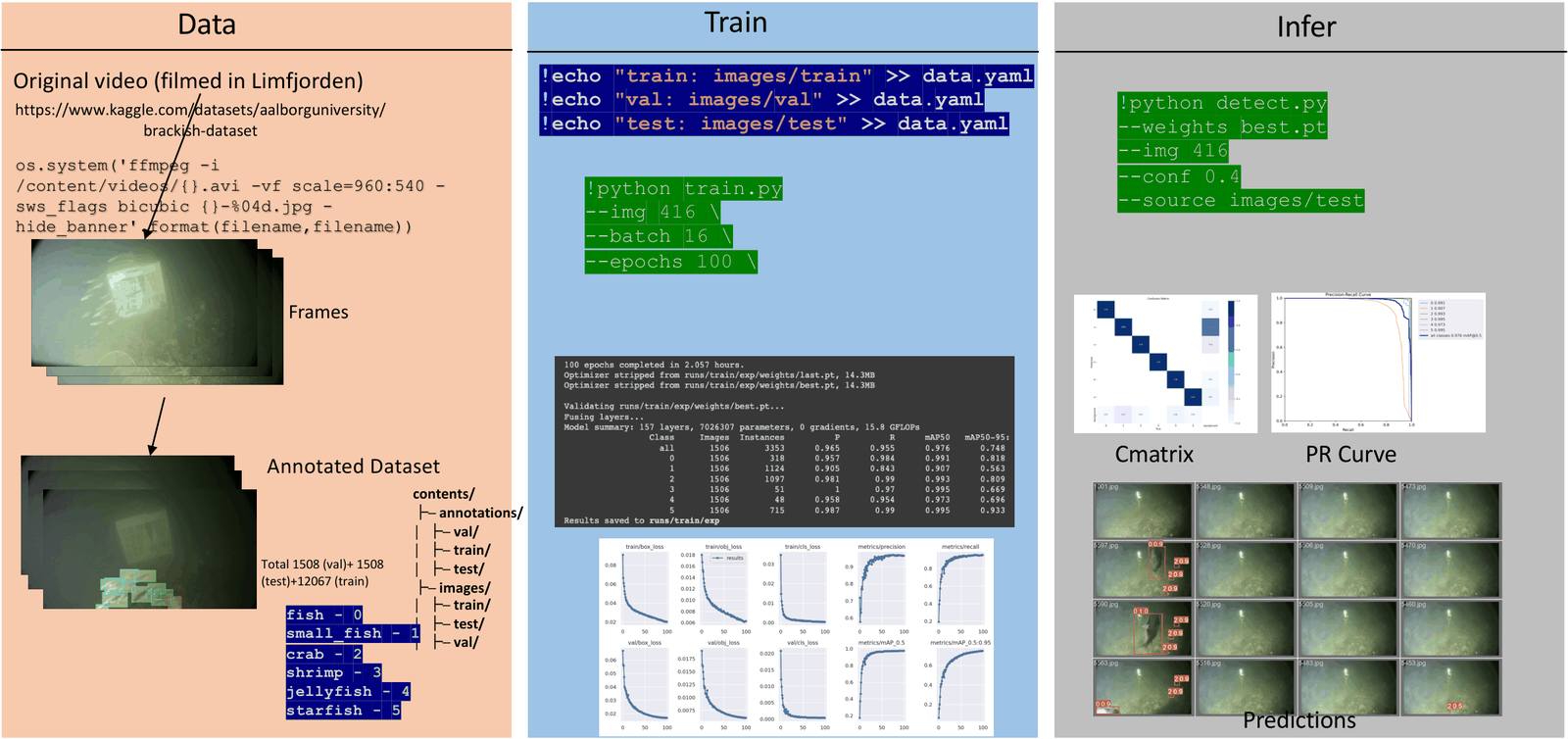
The Data → Train → Infer workflow followed for every detector, from the final report.
5What the committed runs show
The repository keeps one training run per detector, with logs, weights and saved predictions.
Everything in this section is parsed from those files.
Run
Toolkit
Data
Input
Schedule
Params
AP@0.5
AP@[.5:.95]
EfficientDet-Lite0
TFLite Model Maker
Roboflow, test 1,000
320²
350 ep, batch 64
3.24 M
0.898
0.601
YOLOv5s
Ultralytics YOLOv5
own split, val 1,506
416
100 ep, batch 16
7.04 M
0.976
0.748
YOLOv8s
Ultralytics 8.0.20
Roboflow, val 2,000
800
100 ep, batch 16
11.13 M
0.988
0.836
Faster R-CNN X101-FPN
Detectron2
Roboflow, test
default
300 iter, batch 4
—
0.433
0.204
Splits and input sizes differ between runs, so compare shapes and orders of magnitude rather than third
decimals. The EfficientDet-Lite0 row is the float model; the exported TFLite file scores 0.863 and 0.561. YOLO rows are
the validation scores at the last epoch of the committed run.
Validation accuracy during training
Repository logsHover to read all runs at one epoch. Click a legend entry to hide a run.
Metric
Which animals are hard
Repository logsAP@[.5:.95] per class. Hover a dot.
All four detectors find starfish, which rarely move on the seabed, the
easiest class. For the three one-stage detectors small fish, which swim through the frame in groups, are the
hardest; the short Detectron2 run struggles most with shrimp. The strict metric averages over IoU thresholds from
0.5 to 0.95, so it rewards tight boxes rather than rough hits. The committed 100-epoch YOLOv8s run saved per-class results
only as plots, so its dots come from the shorter 25-epoch run whose validation table is printed in the notebook.
Look at the predictions
YOLOv5s against YOLOv8s on the same frame
Pick a frame, then drag across it. Arrow keys step through frames.
The two toolkits number classes differently: YOLOv5 from 0, the Roboflow export
used for YOLOv8 from 1. The order is the same.
YOLOv5sYOLOv8s
↔
EfficientDet-Lite0 on ten Brackish frames
Click to enlarge. Labels read class id and confidence.
Diagnostics saved with each YOLO run
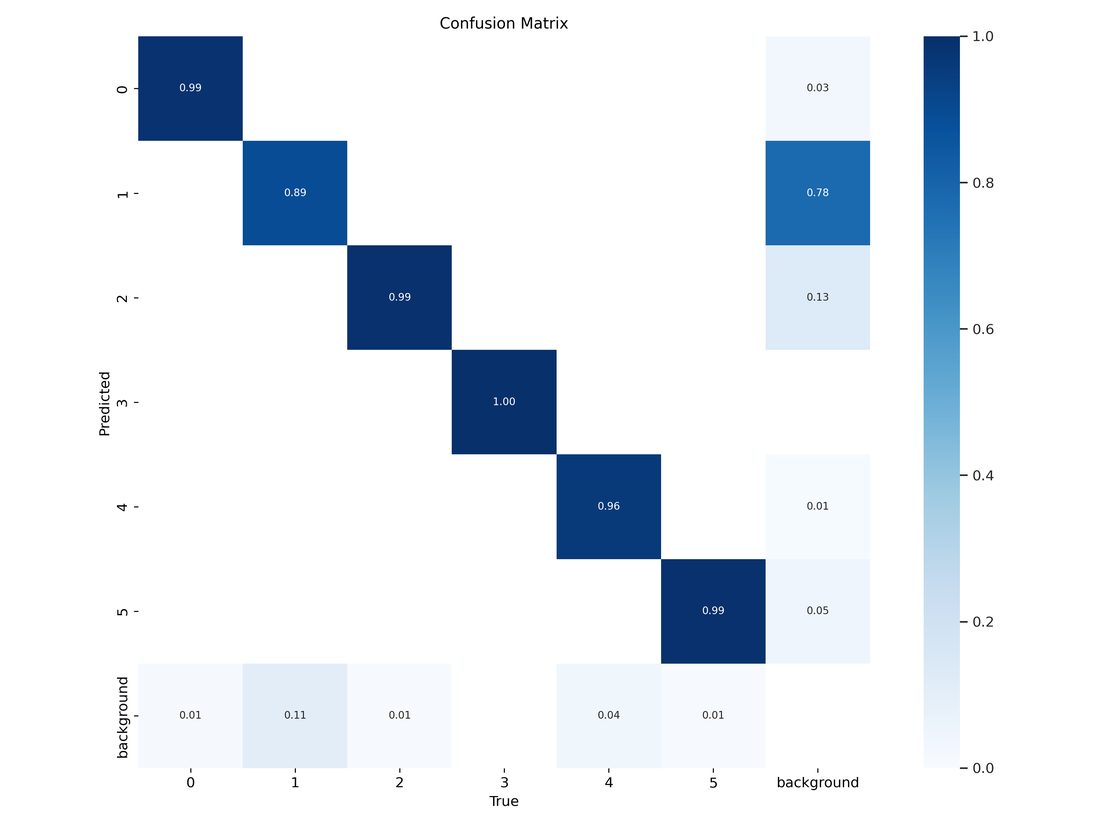
Click an image to enlarge.
6Perturbations and explanations
Two further ideas in the paper: train on deliberately perturbed frames so the model shrugs off noise,
and open the black box to check it looks at the animal, not the water.
Universal adversarial perturbations
A universal adversarial perturbation (UAP, Moosavi-Dezfooli et al., 2017) is a single, image-agnostic noise
pattern, small enough to be nearly invisible, that pushes a network towards wrong predictions on most inputs.
The paper adds UAP noise to training frames in a curriculum, a form of adversarial learning, and reports 98.63%
mAP for EfficientDet and 98.04% for YOLOv5 trained this way.
The key word is universal: the same pattern is added to every frame. The panel below shows what that
means at different strengths.
One pattern, every frame
IllustrationDrag the strength. The pattern is random, not optimised against any model.
crab frame + δfish school + the same δδ itself, amplified
Where does the detector look?
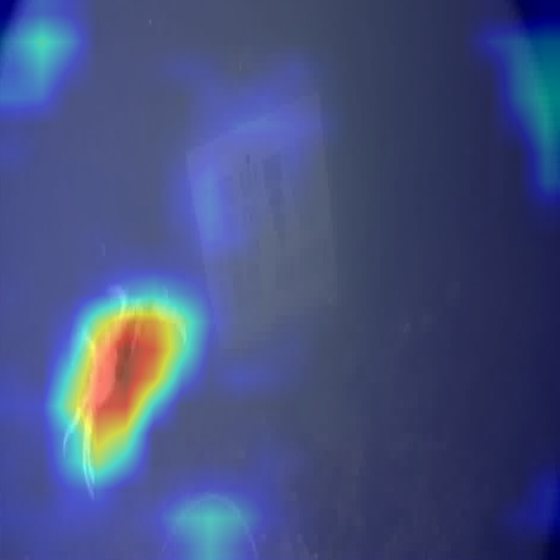
Class activation maps colour each pixel by how much it drives the network's output. GradCAM++, the method the
paper describes, weights the last convolutional feature maps by positive gradients of the class score:
Lᶜ(x, y) = ReLU( Σₖ αₖᶜ · Aₖ(x, y) )
The CAM notebooks in the repository use EigenCAM from pytorch-grad-cam, which needs no gradients:
it projects the activations of one layer onto their first principal component. The maps below are the images
those notebooks saved.
Class activation map viewer
Repository notebooksChoose a frame and a notebook, then slide between the detections and the map.
7Reproducibility and limitations
What a reader should know before building on these numbers.
Paper and repository side by side
Detector
Paper, Table 5 mean
Committed run, AP@0.5
Committed run setup
EfficientDet
98.6 ± 1.0
89.8 (test), 86.3 as TFLite
EfficientDet-Lite0, TFLite Model Maker, 350 epochs
YOLOv8
98.2 ± 0.17
98.8 (val)
YOLOv8s, 100 epochs, 800 px
YOLOv5
97.6 ± 0.61
97.6 (val)
YOLOv5s, 100 epochs, 416 px
Detectron2
95.2 ± 1.4
43.3 (test)
Faster R-CNN X101-FPN, 300 iterations
Scope of the repository.
Each detector has a single committed run. The five repetitions behind Table 5 are not in the repository.
The EfficientDet notebook trains the stock efficientdet_lite0 specification from TFLite Model Maker.
Code for the BiSkFPN neck, the Swish changes, UAP generation and adversarial training is not included.
The four CAM notebooks load YOLOv5-format checkpoints through torch.hub and run EigenCAM. They differ in
the checkpoint they download and the confidence threshold, not in detector architecture.
Table 6's Detectron2 row (28.1, 14.5, 8.6, 3.8, 26.1, 40.6) closely matches the per-class COCO AP@[.5:.95] logged in
4_Detectron2.ipynb for classes 1–6 (28.8, 14.6, 8.6, 3.9, 25.7, 40.7), while Table 5 reports 95.2 for the same model.
The two tables therefore do not report one consistent metric.
The paper and its Table 3 name classes after video folders (fish-school, fish-small…). The boxes use six object
classes: fish, small fish, crab, shrimp, jellyfish and starfish.
Limitations that apply to any result on this data
Neighbouring frames leak. Frames are cut from continuous video, and consecutive frames are nearly identical.
A random split puts near-duplicates into both training and test sets, which inflates every score. Splitting by
video would give a harder and more honest estimate.
AP@0.5 is near its ceiling. Several detectors pass 0.97, where differences shrink to noise. The stricter
AP@[.5:.95], and per-class numbers for the rare shrimp and jellyfish classes, separate models far better.
One site, one camera. Every frame comes from the same fixed rig in Limfjorden. Nothing here shows transfer to
other water, depths, lighting or cameras.
Classes are imbalanced. Shrimp and jellyfish together make up only 3–4% of the validation boxes. A single mean hides how
a model does on exactly the animals that are hardest to monitor.
8Code and citation
Every experiment is a notebook that runs top to bottom on Google Colab or AWS SageMaker.